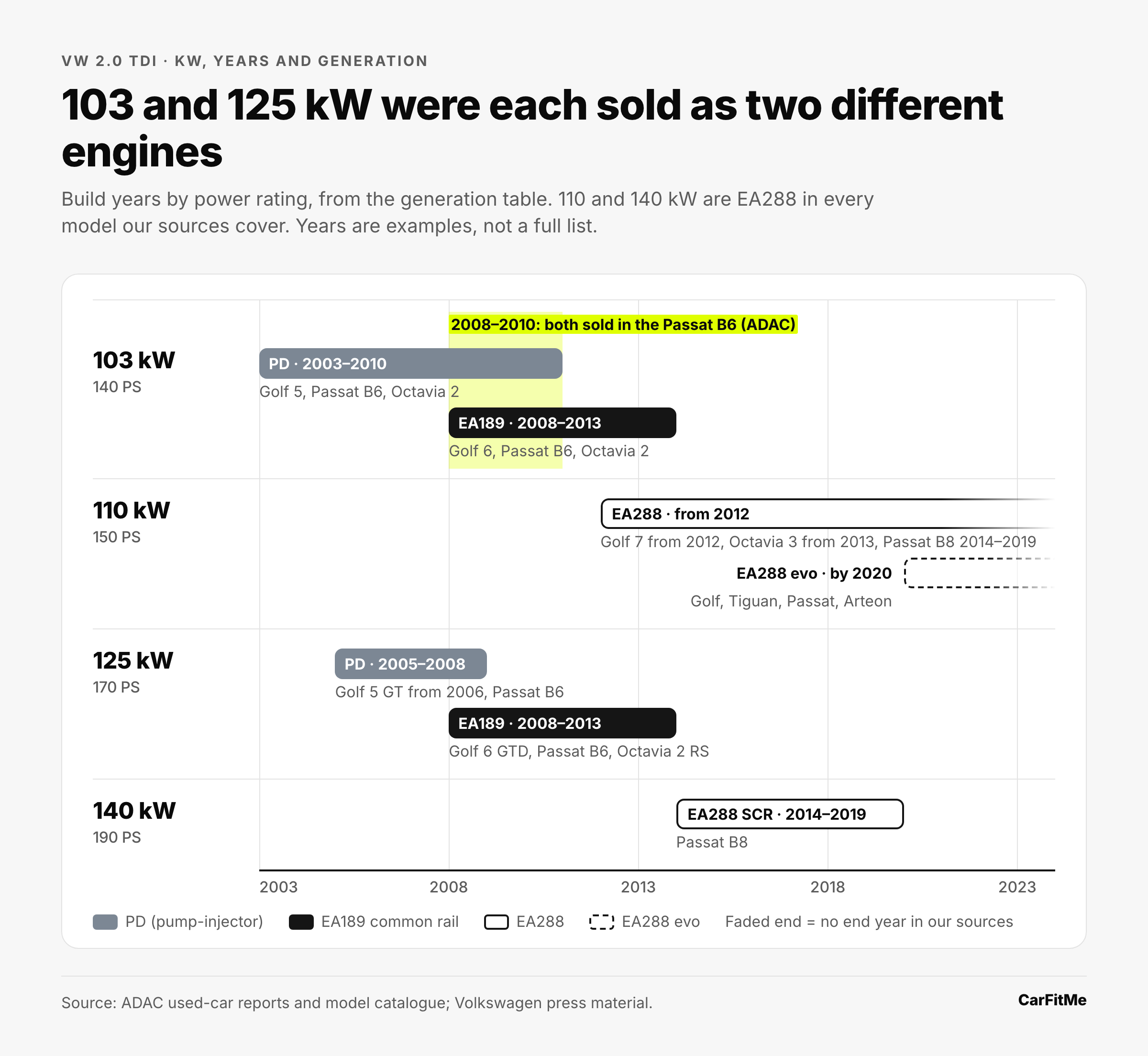
A 2.0 TDI 110kW listing tells you the engine's power, not which generation you're buying, and the problems depend on the generation. In a VW or Škoda from 2012 on, 110 kW is the EA288 in every model our sources cover: Golf 7, Octavia 3 and Passat B8. The 103 and 125 kW ratings are trickier. Each was sold as the older pump-injector (PD) engine and as the EA189 common-rail engine that replaced it. So identify the generation first. The engine code settles it.
One mix-up: the "2.0 TDI 110 hp" you'll also see is a different version, 81 kW (110 PS), sold in the Golf 6 in 2008–2009 per ADAC's Golf 6 diesel report.
Which 2.0 TDI is it? kW, years and generation in one table
Three generations share the badge: PD from 2003, EA189 common rail from 2008, EA288 from 2012. Find your kW (PS is metric horsepower), then model and year. Fits two rows? Read on.
| kW (PS) | Generation | Examples with build years | Euro class on the papers | Timing belt (ADAC) |
|---|---|---|---|---|
| 103 kW (140 PS) | PD (pump-injector) | Golf 5 2003–2008; Passat B6 2005–2010; Octavia 2 2004–2009 | Euro 4 | 150,000 km |
| 103 kW (140 PS) | EA189 common rail | Golf 6 2008–2012; Passat B6 2008–2010; Octavia 2 2010–2013 | Euro 5 | 210,000 km (Octavia 2: 150,000 km) |
| 110 kW (150 PS) | EA288 | Golf 7 from 2012; Octavia 3 from 2013; Passat B8 2014–2019 | Euro 5 early on (Golf 7, Octavia 3 to 04/2015), then Euro 6 | 210,000 km |
| 110 kW (150 PS) | EA288 evo | By 2020 in Golf, Tiguan, Passat and Arteon | Euro 6d | Not in ADAC's tables: check the schedule |
| 125 kW (170 PS) | PD (pump-injector) | Golf 5 GT from 2006; Passat B6 2005–2008 | Euro 4 | 150,000 km |
| 125 kW (170 PS) | EA189 common rail | Golf 6 GTD 2009–2012; Passat B6 2008–2010; Octavia 2 RS 2009–2013 | Euro 5 | 210,000 km (Octavia 2 RS: 150,000 km) |
| 140 kW (190 PS) | EA288 with SCR (AdBlue) | Passat B8 2014–2019 | Euro 6 | 210,000 km |
Sources: ADAC used-car reports and model catalogue, Volkswagen press material. Years are examples, not a full list; other VW-group models changed over at different times.
You'll also see the 81 kW above, 135 kW (184 PS: Golf 7 GTD and Octavia 3 RS, 210,000 km belt), 147 kW (200 PS: Passat B8 2020–2023, Euro 6d) and 176 kW (240 PS BiTDI: Passat B8, 120,000 km belt). Not covered in detail here.
Three clues on the listing, and the one check that settles it
Same badge, different engines. A listing gives you three clues, none final. If the ad is in Lithuanian, here's which field on a Lithuanian listing shows the engine.
Clue 1: first registration and model generation. ADAC's Passat B6 report lists a 103 kW 2.0 TDI built 2005–2010 (150,000 km belt) next to one built 2008–2010 (210,000 km belt). A 2009 Passat at 103 kW could be either.
Clue 2: the Euro class, on the registration document or in the ad. Euro 4 points to the PD, Euro 5 to common rail, though ADAC's Passat B6 table even lists the 2008–2010 common-rail 103 kW as Euro 4. And the early EA288 was Euro 5 too: the Golf 7 from 2012 and the Octavia 3 110 kW from 02/2013 to 04/2015. So Euro 5 alone doesn't prove EA189.
Clue 3: an AdBlue filler, which VW's Passat B8 press kit puts under the fuel flap. AdBlue means SCR, the system that cuts NOx with a urea solution. But the 110 kW Passat B8 launched with a NOx storage catalyst instead, and ADAC only lists a "2.0 TDI SCR" at 110 kW from 2017. No filler doesn't rule out EA288.
The check that settles it: the engine code. ADAC's catalogue lists one per variant. A Golf 2.0 TDI 103 kW built 10/2003–08/2008 is code BMM, pump-injector, Euro 4. One built 10/2008–04/2010 has a code containing CFF, common rail, Euro 5. The 2013–2015 Octavia 110 kW has one containing DFF.
To get it, have a VW-group dealer decode the VIN, or ask the seller for a photo of the vehicle data sticker, which lists the engine code. Škoda's Octavia manual places it in the service schedule and on the boot floor.
Got a 2.0 TDI listing open? Paste the link to see the known faults for that car and when its engine's weak points tend to show up. Free. Works with autoplius.lt, autogidas.lt, mobile.de and AutoScout24 listings, among others.
PD (pump-injector), 103 and 125 kW: belt discipline and the 170 PS injectors
In the Golf, the 2.0 TDI arrived with the Golf 5 in October 2003, at 103 kW. It uses what VW calls "pump-nozzle" injection, where each cylinder's injector has its own high-pressure pump built in. ADAC's Golf 5 report says every Golf 5 TDI is a PD.
The belt matters most here: ADAC calls changing it on schedule (150,000 km) enormously important for engine life. The 125 kW (170 PS) PD uses piezo injectors, and ADAC's Passat B6 report calls it more susceptible than the 140 PS version.
One recall to ask about. In March 2006, Golf 5 and Golf Plus 2.0 TDI cars with the 6-speed manual built 10/2003–05/2005 were called back because a vent valve in the clutch line could damage the dual-mass flywheel (the part that smooths the engine's shudder) and, in unfavorable cases, cause a fire. If it hasn't been done, have it done and the car inspected before regular driving.
Check: a belt invoice with the date and km, and the recall entry in the service book or on a dealer printout.
EA189 common rail, 103 and 125 kW: the NOx update, injectors and EGR
With the Golf 6 in 2008, VW moved the 2.0 TDI to common rail: per VW's Golf estate presentation, these Euro 5 engines replaced the pump-nozzle ones. This is the EA189, the engine at the center of the emissions case.
The NOx update. In the EU, EA189 engines got a fix approved by type-approval authorities such as the KBA, Germany's motor transport authority. For the 2.0 it was software, rolled out from January 2016, and the KBA found no unfavorable changes in fuel consumption, power, torque or noise (Volkswagen AG annual report 2016). ADAC's buyer advice for the Golf 6, Passat B6 and Octavia 2: check that the mandatory update was done.
Known faults. ADAC lists the injectors as a frequent component fault on 2011 Golf 6 and Octavia 2 registrations. On the Superb 2, exhaust gas recirculation (EGR, the valve that feeds some exhaust back into the intake) is a frequent breakdown cause for 2011–2013 registrations (ADAC Superb 2 report).
Recalls. A January 2012 campaign covered 2.0 CR TDI engines whose high-pressure fuel lines could crack from vibration and leak (signs: fuel smell, rough running). In February 2018, Golf 6 1.6 and 2.0 TDIs built 03–06/2011, and other VW models, were recalled because the starter solenoid could stay powered and overheat, a fire risk. Smell fuel from the engine bay? Don't keep driving it. Have it inspected.
The fuel pump, a US case. NHTSA investigated high-pressure fuel pump failures on 2009–2012 US-market Golf, Jetta and A3 TDIs: rough running, power loss, occasionally a stall, usually after a warning (glow-plug lamp, limp mode). VW blamed misfueling with petrol. NHTSA closed the case in 2015 without ordering a recall, noting that this isn't a finding that no defect exists. See those warnings on a test drive? Stop and have the car inspected.
Check: a dealer VIN check for the NOx update and recalls, injector or EGR invoices, a cold start.
125 kW (170 PS): two engines, both rarer
Rows 5 and 6 are one power output on two engines: PD until about 2008, then EA189, which reached the Golf with the Golf 6 GTD in 2009, at Euro 5. ADAC calls the 170 PS diesels rare on the used market, and in the Golf 5 pricier too.
Check: know which of the two it is before you read any "170 PS TDI" review.
EA288 at 110 kW: the Golf 7, Octavia 3 and Passat B8 engine
The EA288 arrived in 2012 with the Golf 7, as a 2.0 TDI at 110 kW (150 PS). ADAC's Golf 7 report says these engines aren't affected by the emissions scandal. Not affected isn't the same as fault-free.
Known faults. The coolant pump, which moves coolant through the engine, is a frequent component fault on 2013 Octavia 3 registrations. Boost-pressure control, which regulates the turbo's pressure, shows up for the Octavia 3 (2015) and the Passat B8 (2015 and 2017).
Exhaust cleaning differs by version. As clue 3 showed, the early 110 kW Passat B8 had no AdBlue and later "SCR" versions do. The evo uses "twin dosing": two AdBlue-fed SCR catalysts, the first next to the engine and doubling as the particulate filter (Volkswagen, December 2020).
Check: belt at 210,000 km or the schedule's time limit, coolant-pump history, a scan for boost-pressure faults, AdBlue warnings if fitted.
140 kW (190 PS): the same EA288, with AdBlue from the start
The 140 kW EA288 came with the Passat B8 in 2014, with 400 Nm (VW press kit). ADAC lists it as "2.0 TDI SCR" from launch, Euro 6b, so it has an AdBlue filler. ADAC rates the Passat B8 above average for breakdowns and notes typically very high mileages. Its fault notes are the Passat B8 ones above (boost-pressure control), with nothing 140 kW-specific.
Check: AdBlue warnings, a service book that covers the mileage, and the belt at 210,000 km.
Timing belt: when it's due on each generation
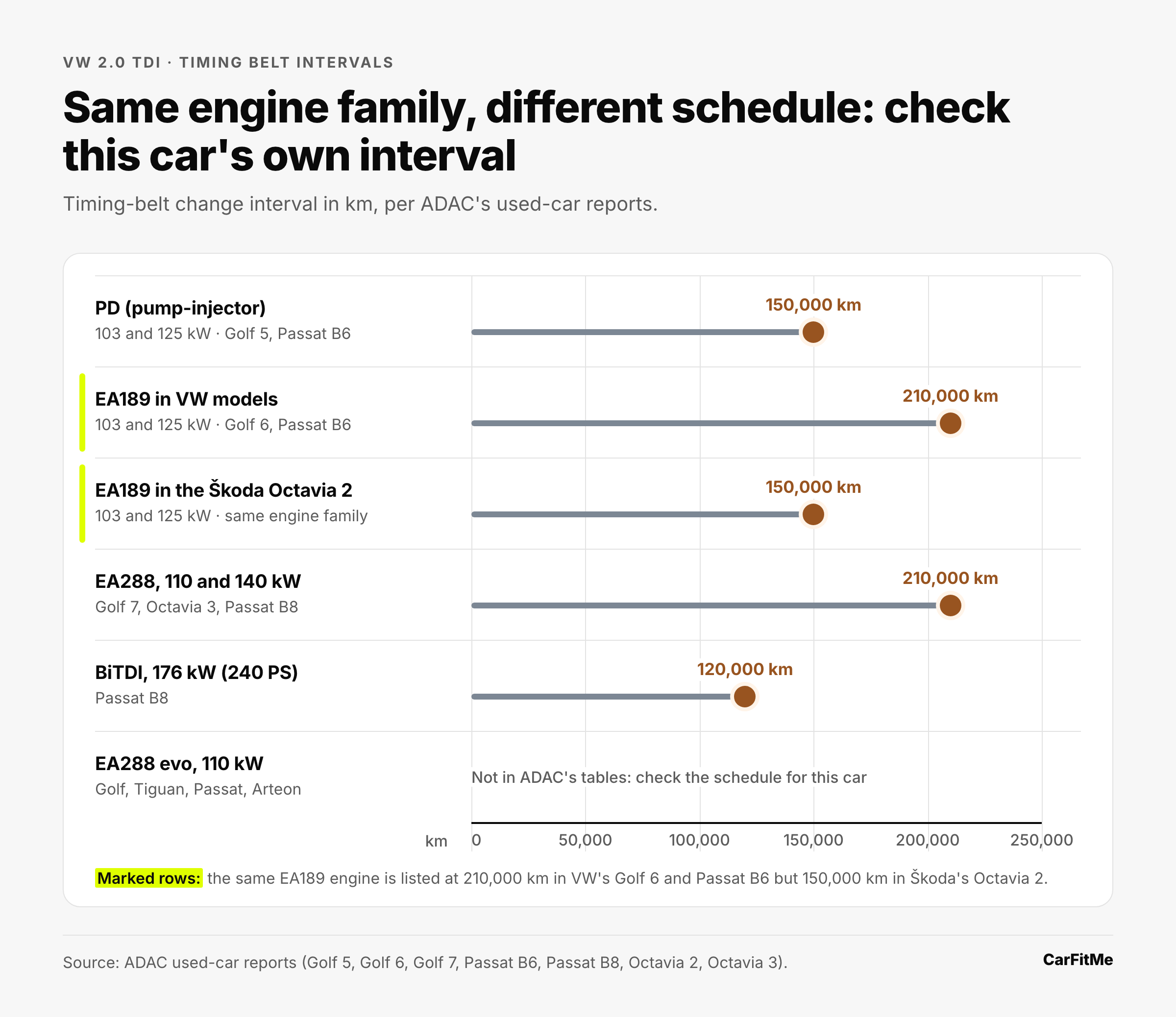
All three generations use a toothed belt. ADAC's intervals: 150,000 km on the PD and 210,000 km on the EA288 (Golf 7, Octavia 3, Passat B8). The EA189 is 210,000 km in VW's Golf 6 and Passat B6 but 150,000 km in Škoda's Octavia 2 table: same engine, different brand, different number. The 176 kW BiTDI is 120,000 km. Go by this car's own schedule, not a forum figure.
ADAC's reports also give German workshop prices for a belt job, parts and fitting included: roughly €440–620 on the PD (Golf 5, Passat B6), €630–980 on the EA189 (Octavia 2, Passat B6, Golf 6) and €730–1,030 on the EA288 (Octavia 3, Golf 7, Passat B8). The reports don't date them (retrieved November 2026), and a Lithuanian workshop will quote differently, so ask.
Check: an invoice naming the belt and what else was replaced, with date and km. No invoice means budget for the job.
What to check before you buy
- Get the engine code (dealer VIN decode or data-sticker photo) and match it to the table to know which section applies.
- Timing belt invoice with date and km, against the interval for that generation and brand (150,000, 210,000 or 120,000 km per ADAC).
- Dealer VIN check for open campaigns: the NOx update on EA189 cars, plus safety recalls like the 2012 fuel-line and 2018 starter ones. ADAC notes campaigns leave a sticker near the spare-wheel well and a service-book entry (Passat B6), so ask to see them.
- Cold start, then a test drive. Warning lights should go out after start-up. A glow-plug lamp, limp mode, rough running, lost power or a fuel smell means workshop before money.
- On an EA288 with AdBlue, ask about AdBlue or emissions warnings, and look at the coolant-pump and boost-pressure repair history.
- Workshop scan, generation named: stored fault codes (injectors, EGR, boost), in writing for the price talk.
See a sample report to see what a check plan for one specific car looks like.
FAQ
Is the 2.0 TDI reliable?
It depends on the generation and on the car's history. In ADAC's breakdown statistics, the Golf 6 diesel does above average and the Passat B8 does well, while the Passat B6 sits near the back, which ADAC partly puts down to very high mileages. So find the engine code first, then check the belt invoice, the recall history and a workshop scan for the car in front of you.
Is 2.0 TDI better than 1.9 TDI?
Neither is better across the board. In its Golf 5 report, ADAC calls the 105 PS 1.9 TDI a long-runner and recommends the 140 PS 2.0 TDI if you drive a lot on the motorway. Which suits you depends on how you drive, and the specific car's maintenance history matters more than the badge. Compare the service records of the two cars you're choosing between.
2.0 TDI 110 kW vs 147 kW: what's the difference?
Both are 2.0 TDIs from the Passat B8 era. The 147 kW (200 PS) is the later one, built 2020–2023 and rated Euro 6d in ADAC's data, while the 110 kW is the 150 PS EA288 sold from 2012. Whichever you're looking at, check the engine code, the timing belt invoice and whether AdBlue or emissions warnings have appeared.
What is the 2.0 TDI 110kW engine code?
There isn't a single code. It depends on the model and the year: ADAC's catalogue lists the 2013–2015 Octavia 2.0 TDI 110 kW with a code containing DFF, and other models and years differ. Get the code for the actual car from a dealer VIN decode or the vehicle data sticker, then match it to the generation table above.
Does the EA288 use a timing belt or chain?
A belt. ADAC's tables give a 210,000 km change interval for the 110 and 140 kW EA288 in the Golf 7, Octavia 3 and Passat B8, and 120,000 km for the 176 kW BiTDI. Intervals differ by brand and version, so read the schedule for this car's engine code and ask for the invoice from the last change.
This guide describes known faults and recalls from the sources named. It isn't an inspection or a recall check of a specific car: have a qualified workshop inspect it and a dealer check open recalls by VIN before you buy.