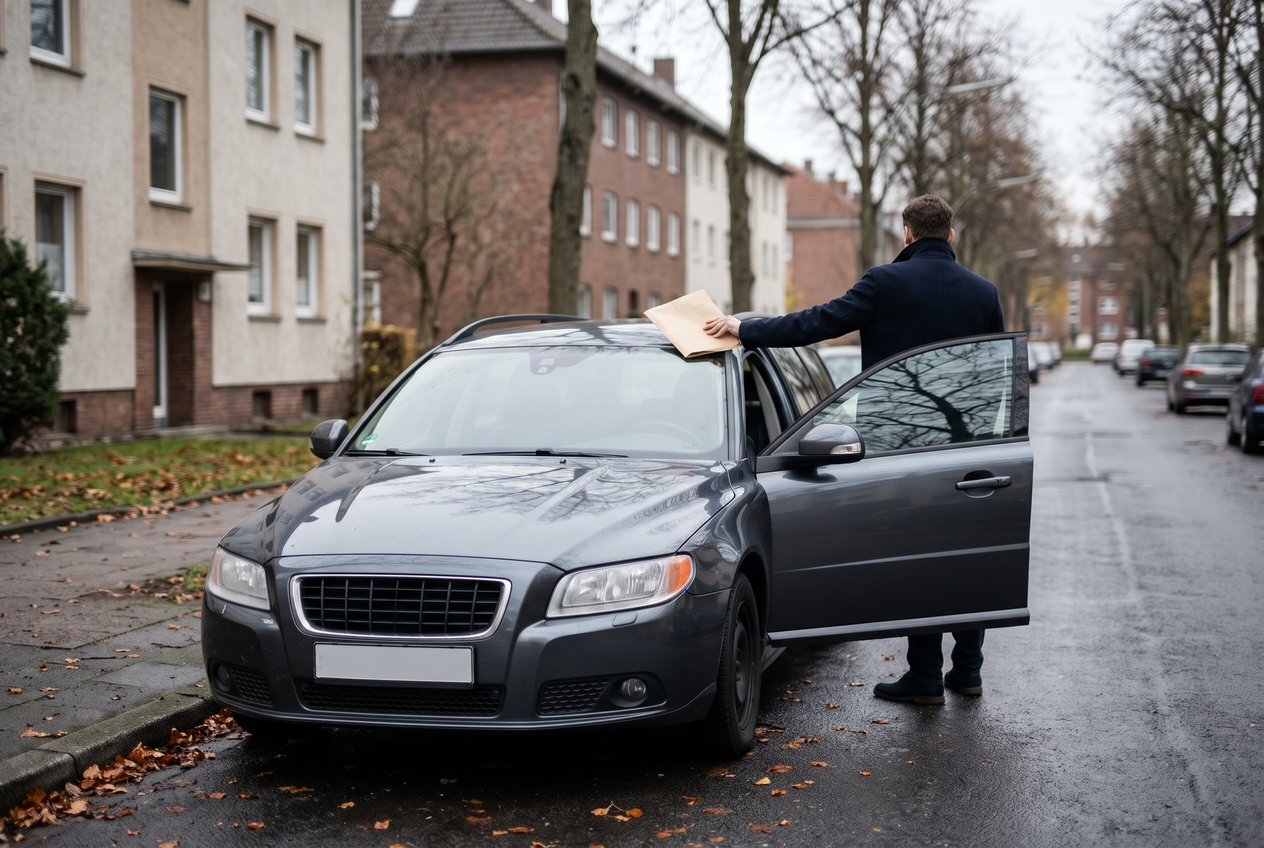
Buying a used car in Germany for export to Lithuania is something you can do as a non-resident. The purchase is a private contract between you and the seller, private owner or dealer. Most of what goes wrong shows in the paperwork, and you can read it from your sofa before you book the trip.
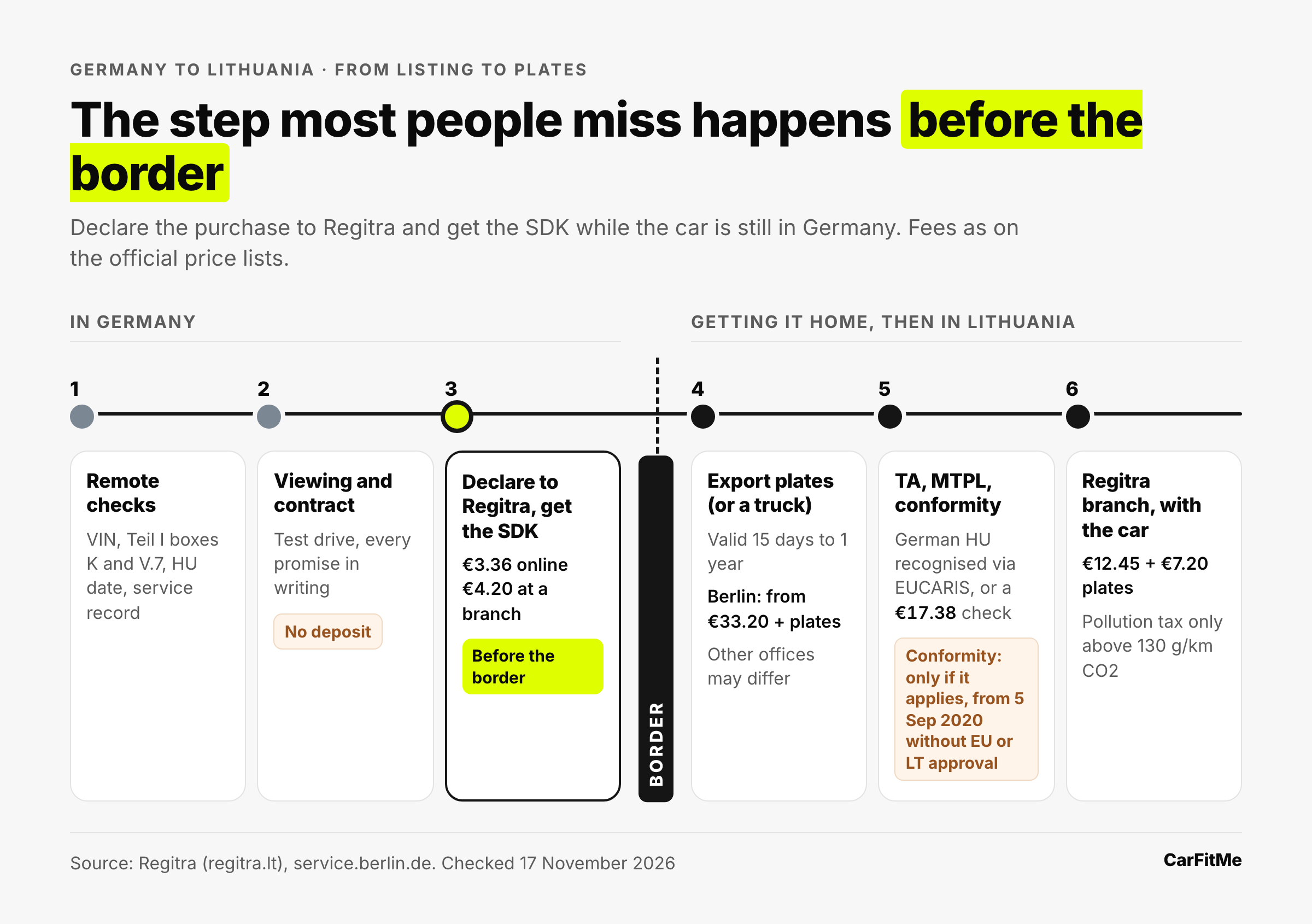
The path, in one breath: check the listing and its documents remotely. View the car and sign a written contract. Declare the purchase to Regitra and get the SDK (owner declaration code) before the car enters Lithuania (Regitra). Drive it home on German export plates (Ausfuhrkennzeichen) or have it transported. Then a roadworthiness test, MTPL insurance, and registration at a Regitra branch with the car present.
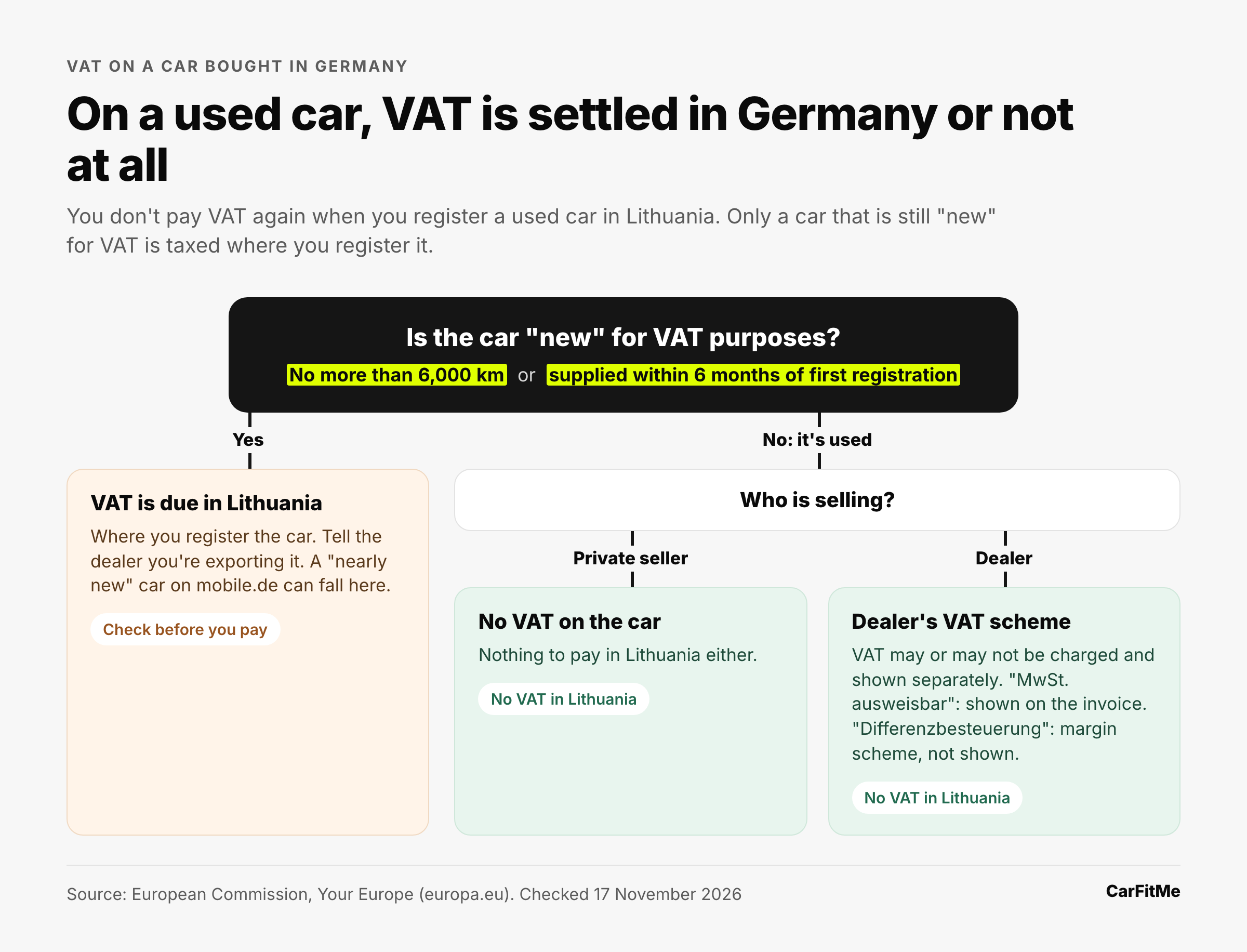
VAT, in one line: on a used car (more than 6,000 km and more than 6 months since first registration) you don't pay VAT in Lithuania when you register it (Your Europe).
Before you book the trip: five checks on the listing
A trip to Germany costs a weekend and the fare. Five photos from the seller tell you whether it's worth it. Ask for them in a mobile.de or AutoScout24 message:
- The VIN, photographed on the car, matching the one in the listing.
- Zulassungsbescheinigung Teil I, registration certificate part I. Two boxes matter. Box K holds the type-approval number "if available", and box V.7 holds CO2 in g/km (Directive 1999/37/EC, Annex I). An empty K on a car first registered on or after 5 September 2020 is worth asking about (the Lithuania section explains why). V.7 is the CO2 figure Lithuania's registration tax uses first.
- Teil II (the old Fahrzeugbrief), the second registration document. It names the keeper, not legally the owner. Check that it exists and that the name on it matches the seller.
- The HU report. The Hauptuntersuchung is Germany's roadworthiness test. Note the expiry date: export plates need a valid HU, and Regitra can later recognize it.
- The service record, the Scheckheft (service book) or a digital printout, with the mileage at each entry. A gap or a jump is your next question.
Then look past the model to the version. The engine and gearbox tell you more than the badge, and they decide what you'll look for at the viewing. For the rest, use the questions we'd send any seller before a viewing.
Got the mobile.de or AutoScout24 listing open? Paste the link to see the known faults for that car and when its engine's weak points tend to show up, before you book the trip. Free. The inspection plan for that exact car is in the full report.
Reading the price: "MwSt. ausweisbar", "Differenzbesteuerung" and when VAT is due
German ads often put a VAT label next to the price. The European Commission's Your Europe guide sets out who pays what:
- "New" for VAT purposes means no more than 6,000 km, or supplied within 6 months of first registration. VAT is then due where you register the car, Lithuania, and you must tell the dealer you're exporting it. A "nearly new" car on mobile.de can fall into this group.
- Used, from a private seller: in Your Europe's words, "you don't have to pay VAT on the car."
- Used, from a dealer: VAT "may or may not be charged and mentioned separately", depending on how the dealer calculates it. That's what the ad labels mean. "MwSt. ausweisbar": VAT can be shown separately on the invoice. "Differenzbesteuerung": the margin scheme, where it isn't shown. Either way, as a private buyer of a used car you don't pay VAT again when you register it in Lithuania.
If a dealer offers you, a private buyer, a "net" or "export" price, that's a question for the dealer and the tax authority. It isn't a trick to use.
Ask the seller in writing: private sale, or dealer? And if dealer, under which VAT scheme?
Private seller or dealer: what "Händlerkauf" and "Verkauft wie gesehen" mean for you
According to ECC Germany, a seller can exclude the warranty on a used car only in a private sale or a sale between two traders. A dealer selling to you as a consumer can't, which is why some dealer contracts quietly turn you into a trader.
Phrases from ECC Germany's list:
| In the contract | What it means | What to do |
|---|---|---|
| Händlerkauf / Händlergeschäft | Buyer and seller are traders | Strike it if you're buying privately |
| Käufer bestätigt, Gewerbetreibender zu sein | Buyer confirms being a trader | Don't sign it as a consumer |
| Unter Ausschluss jeglicher Gewährleistung | Excluding any warranty | Read the whole clause |
| Ausschluss der Sachmängelhaftung | Exclusion of liability for material defects | From a dealer, ask why it's there |
| Verkauft wie gesehen | Sold as seen | Write the known defects in instead |
| Nebenabreden bedürfen zu ihrer Gültigkeit der Schriftform | Side agreements must be in writing to be valid | Put every verbal promise on paper |
ECC Germany's advice in one line: never pay a deposit, and buy only after a thorough inspection and test drive.
Before you sign: no clause that calls you a trader, and every promise in writing. The service just done, the new tires, "no accidents".
The handover: what you leave Germany with
- A signed purchase contract naming you, the price, the date and the mileage. You attach it to the SDK declaration.
- Teil I and Teil II, the HU report, all the keys and the service record.
- The CoC (certificate of conformity), if there is one. It isn't on Regitra's document list for an EEA-registered car. Ask for it anyway: Regitra takes the CO2 figure from the registration certificate or the CoC (Regitra). Useful, not listed as required.
Having a workshop near the seller look at it? Take what to hand the workshop.
Before the border: declare the purchase and get the SDK
A car registered in Germany has no SDK. So, says Regitra, before importing it into Lithuania you declare the purchase and get one. Two routes:
- Online on e-Regitra, attaching the purchase contract.
- At a Regitra branch, with your ID card or passport and the contract (copies are accepted). An authorized person can go for you.
The fee on Regitra's price list, checked 17 November 2026: €3.36 online, €4.20 at a branch.
Do it from your phone the evening you sign, while you're still in Germany. It's the cheapest step and the easiest one to forget.
That page gives no registration deadline (checked 17 November 2026). If you read a fixed number of days elsewhere, check it with Regitra. In practice, your export plates and their insurance set the clock.
Getting it home: export plates, not 5-day plates
Export plates (Ausfuhrkennzeichen) are for a car leaving Germany to stay abroad. The Berlin registration office asks for your ID and application, Teil I and Teil II, a valid HU report, the old plates (no deregistration needed first), an insurance confirmation for export plates, and a SEPA direct-debit mandate for the German vehicle tax (Kfz-Steuer).
They're valid for 15 days to 1 year, depending on the insurance and the office's decision. In Berlin the fee is €33.20 in the cheapest case, plus the plates. Fees at other offices may differ.
The non-resident catch: applicants without a residence in Germany must name an authorized recipient (Empfangsbevollmächtigter). In Berlin, that person must live in Berlin, or live in Germany and be staying in Berlin. Sort out who before you travel.
5-day plates (Kurzzeitkennzeichen), the yellow ones, are a different tool. Per ADAC, they're valid for at most five days plus the day of issue, for test, inspection and transfer drives. As a national plate they come with no guarantee abroad. ADAC lists agreements with Austria, Italy, Denmark and Switzerland. Lithuania and Poland aren't on that list.
A truck is the third option: compare transport quotes for your route.
Before you book the plates, check the HU date. Under FZV § 45, the next HU must fall due after the export plates expire, or the test comes first. Then check that the insurance starts on the day you drive off.
In Lithuania: TA, insurance, the 1 October 2026 rule, then Regitra
Regitra's import page sets the order after the SDK.
- Roadworthiness test (TA). Your German HU can count. Regitra recognizes an EEA test certificate at registration if it meets Directive 2014/45/EU and is recorded in EUCARIS (the data-exchange system Europe's vehicle registries share), is still valid under Lithuania's TA interval, and the car has no destruction or traffic-ban record. If not, you go to a Lithuanian TA station, or pay Regitra €17.38 to check with the origin country. Here's how often a car needs a TA in Lithuania.
- MTPL insurance, third-party liability cover, is mandatory (Motor Insurers' Bureau of Lithuania).
- The 1 October 2026 conformity rule. Regitra's Lithuanian page shows a change the English page doesn't yet: a conformity assessment is now also needed for a car registered in the EU, Norway, Liechtenstein, Iceland or Switzerland without Lithuanian or EU approval, if its first registration or manufacture date is on or after 5 September 2020, or its manufacture or model year is 2021 or later. Box K is where an EU type-approval number would appear. Empty on a car that age? Ask Regitra before you buy.
- Registration at a Regitra branch, booked in advance. Bring the car, your ID or passport, the German Teil I as the previous registration document, and a conformity document if one applies. Regitra's price list, checked 17 November 2026: €12.45 for first registration of a passenger car in Lithuania, €7.20 for a standard plate set. Other items, such as an authenticity check, may apply.
- Registration (pollution) tax. Since 1 July 2020, per Regitra, a tax applies when an imported M1 (passenger) or N1 (light commercial) vehicle is registered. It depends on fuel type and is charged only above 130 g/km of CO2, taken from the registration certificate or CoC: box V.7 again. You pay it at the branch, before registration completes. Regitra's registration tax calculator gives a preliminary amount.
Rules and fees checked on 17 November 2026 on regitra.lt (English and Lithuanian pages), europa.eu, evz.de, service.berlin.de, adac.de and gesetze-im-internet.de. They change, so confirm the current version there before you act. This is general information, not legal or tax advice.
What it adds up to: the costs you can source, and the ones you can't
| Cost | Amount | Source (checked 17 Nov 2026) |
|---|---|---|
| The car | The listing price | Your contract |
| Trip, or truck transport | Your quote | Your booking |
| Export plates, admin fee | From €33.20 in Berlin, plus plates; other offices may differ | service.berlin.de |
| Export-plate insurance, Kfz-Steuer for the plate period | Insurer's quote; tax set by German customs | Insurer, tax notice |
| SDK declaration | €3.36 online, €4.20 at a branch | Regitra |
| TA, or HU recognition | TA: the station's price list. Origin-country check: €17.38 | Regitra |
| MTPL insurance | Insurer's quote | Insurer |
| Conformity assessment, if it applies | The assessment company's price | Regitra (LT) |
| Registration and plates | €12.45 + €7.20; other items may apply | Regitra |
| Registration (pollution) tax | €0 at 130 g/km or less; above that, the calculator | Regitra |
There's no honest total without your car's CO2, fuel type and route. And the biggest number often isn't in this table. It's what this version costs you after it arrives: the repairs it's known for at this mileage.
What to check before you buy
Five checks for the German listing on your screen, before you book anything:
- Boxes K and V.7 on the Teil I photo. Is there a type-approval number in K? Is the CO2 in V.7 above 130 g/km?
- The HU date. It must stay valid for the whole export-plate period. Ideally it's in EUCARIS, so Regitra can recognize it.
- Seller type and VAT scheme, in writing. Private, or dealer with "MwSt. ausweisbar" or "Differenzbesteuerung"? Buying privately? Then no "Händlerkauf" clause.
- No deposit before the viewing, and every promise goes into the contract.
- The version at this mileage. Note the engine and gearbox and find out what they're known for at this mileage. Then you know what to look at and listen for on the test drive.
Still scrolling through German listings? The CarFitMe extension for desktop Chrome puts a card on mobile.de and AutoScout24 ads, and nothing is sent until you click.
FAQ
Can I buy a car in Germany as a non resident?
Yes. Buying a car is a private contract between you and the seller, so you don't need to live in Germany. The catch comes with export plates: the Berlin registration office requires applicants without a residence in Germany to name an authorized recipient (Empfangsbevollmächtigter). If you're registering the car in Lithuania, you also declare the purchase to Regitra and get the SDK before the car enters the country.
How to get export plates in Germany?
You apply at the registration office (Zulassungsstelle). The Berlin office asks for Teil I and Teil II, a valid HU report, the old plates, an export-plate insurance confirmation and a SEPA mandate for the German vehicle tax. The plates are valid for 15 days to 1 year, depending on the insurance and the office. In Berlin the fee starts at €33.20 plus the plates (checked 17 November 2026). Fees at other offices may differ.
Can you buy a car in Germany with cash?
Yes. Germany has no statutory cash limit, but dealers must check your ID for cash payments of €10,000 or more, according to ECC Germany. Lithuania limits cash payments to €5,000, counting the whole transaction, so check which rule applies if part of the deal touches Lithuania. An EU-wide €10,000 limit is due from summer 2027, and it generally won't apply between private individuals.
Can you buy a car in Germany online?
You can find the car, ask questions and negotiate online, and you can check most of its paperwork from photos: the VIN, Teil I, Teil II, the HU report and the service record. ECC Germany advises never paying a deposit and buying only after a thorough inspection and test drive. So plan on seeing the car in person, or sending someone you trust, before money changes hands.
What do I need to buy a car in Germany?
To buy, you need your ID or passport and a written purchase contract that names you, the price, the date and the mileage. Leave with Teil I and Teil II, the HU report, all the keys and the service record. To bring it to Lithuania, you need the SDK from Regitra before the border. A certificate of conformity (CoC) is worth asking for, though Regitra doesn't list it for a car registered in the EEA.