
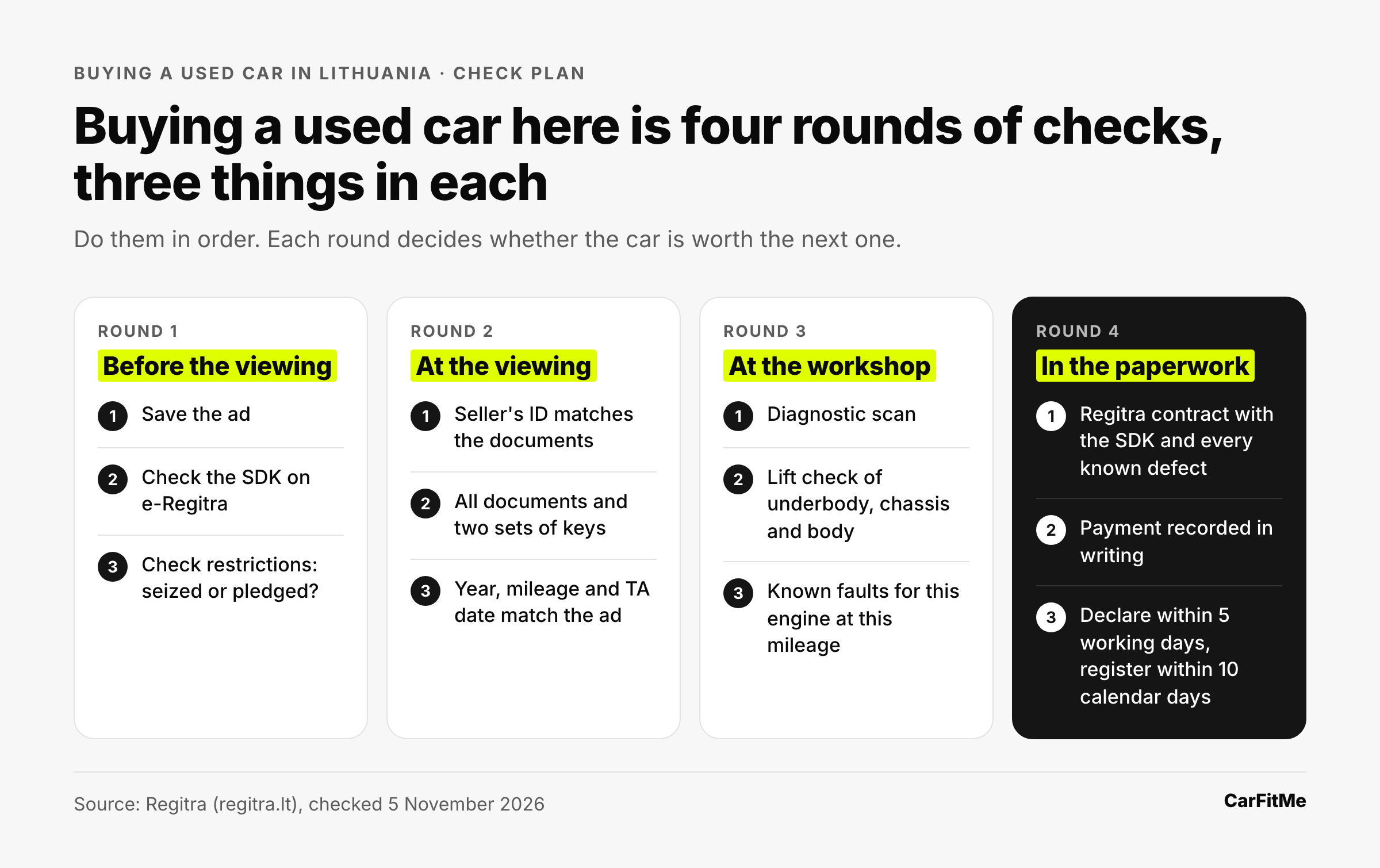
Buying a used car in Lithuania is something you can do yourself, in English, without a broker. Treat it as four rounds of checks: before the viewing, at the viewing, at the workshop, and in the paperwork. The paperwork round is mostly free tools from Regitra, the state vehicle registry.
Can a foreigner buy? Yes. The purchase is a private contract between you and the owner, and Regitra's own pages cover buyers who are foreign residents. Registering it in your name has its own conditions, so check them with Regitra before you pay.
The order, in one breath: check the listing and the car's SDK (owner declaration code) before you go. Inspect the car, ideally at a workshop. Sign Regitra's model contract with every defect written in. Declare the change of owner within 5 working days. Then get a roadworthiness test if it has expired, take out mandatory insurance, and register within 10 calendar days.
Where to look: autoplius.lt, autogidas.lt, and German sites
The two big local marketplaces are autoplius.lt and autogidas.lt. autoplius has an English interface, but most ads are written in Lithuanian, so expect labels and descriptions you can't read yet. The next section fixes that.
Plenty of people also browse mobile.de and AutoScout24 for cars in Germany. That's an import, though: the car gets its first registration in Lithuania, which follows a different path in Regitra's vehicle registration services. This guide covers a car that's already registered here.
How to read a Lithuanian car listing
The labels below come from the Lithuanian versions of live autoplius.lt and autogidas.lt listings, read on 4 November 2026. Where the two sites word a field differently, both versions are given.
| Lithuanian label | What it means | What to do with it |
|---|---|---|
| Pirma registracija (autoplius) / Metai (autogidas) | First registration / year, shown as YYYY-MM | Compare it with the year in the seller's description and in the documents. They can differ, so ask why |
| Rida | Mileage | Ask which records back it up: service book, invoices |
| Variklis | Engine: size and power (kW; AG = horsepower) | This identifies the version. Faults follow the engine family, not the model name |
| Pavarų dėžė: Automatinė / Mechaninė | Gearbox: automatic / manual | "Automatinė" covers very different gearboxes. Ask which one it is |
| Kuro tipas | Fuel type | Diesel, petrol, hybrid and so on |
| Tech. apžiūra iki (autoplius) / TA iki (autogidas) | Roadworthiness test (TA) valid until | If it has expired, the car needs a TA before you can drive it on public roads |
| Defektai (autogidas; "Be defektų" = no defects) | Defects the seller declares | Save the ad. It's what the seller put in writing |
| Kėbulo numeris (VIN) (autoplius) / VIN kodas (autogidas) | VIN | Run a history report if you want the car's past. It doesn't replace a workshop check |
| SDK (autoplius; may sit behind "Rodyti" = show) | Owner declaration code | Ask for it and check it on e-Regitra before you travel to see the car |
The Aprašymas (description) is where sellers list repairs and, sometimes, "Žinomi trūkumai" (known faults). Paste it into a translator and read the known-faults part twice.
You can also filter before you start reading. Both sites have a Galiojanti TA (valid TA) filter and a filter for listings with a VIN ("Skelbimai su VIN" on autoplius, "Skelbimas su VIN" on autogidas). autoplius adds "Nerodyti su defektais", which hides cars with declared defects.
Before you go to see it: version, SDK, restrictions
Three checks from the sofa, all free, plus one habit.
1. Check the version, not the model. A Golf with a 1.4 petrol and a manual gearbox and a Golf with a 2.0 diesel and an automatic are different cars to own. Find out what this engine and gearbox are known for at this mileage, so you know what to ask about.
2. Check the SDK. Enter the code in e-Regitra's SDK validity search. According to Regitra, a car without a valid SDK can't be registered or sold. No valid code, no deal.
3. Check for restrictions. The e-Regitra restrictions search shows whether the car is seized or pledged, in Regitra's wording.
4. Save the ad. Make a PDF or dated screenshots of every page. Regitra calls the ad a public offer that can serve as evidence if the seller withheld information about the car. The same page notes that a price below market value may point to defects.
Got an autoplius or autogidas listing open? Paste the link to see the faults this engine is known for, and at what mileage. Free. The seller questions and workshop list for that exact car are in the full report.
Questions to send the seller before the viewing
Send these as a message. English is fine, since many sellers use a translator anyway, and written answers back up the saved ad.
- Are you the registered owner? If not, who authorized you to sell? (Regitra says to sign only with the real owner or someone legally authorized.)
- Can you send me the SDK so I can check it on e-Regitra?
- Is the car pledged, or still on a lease or loan?
- What service records cover the mileage? Book, invoices, workshop printouts?
- Which gearbox is it exactly, and when was its oil last changed?
- What's been replaced in the last two years, and do you have invoices?
- Any known faults? Would you write them into the contract?
- Was the car imported, and from where?
If an answer changes between the message and the viewing, ask why.
At the viewing and on the test drive
You don't need to be a car person for this. Thirty minutes is enough to decide whether the car is worth a workshop visit.
Start with paper. The seller's ID should match the name on the registration document, and that name goes on the contract. Regitra says to make sure all the car's documents and two sets of keys are handed over, so ask to see both keys now. Compare the year, the mileage on the dash and the TA date with the ad and with the service records.
Then the car. Ask the seller in advance not to warm it up, because a cold start tells you more. Warning lights on the dash should go out a few seconds after the engine starts. Look at the tires: even wear, and a matching set. Check the fluid levels, look for rust along the sills and around the subframe, and see whether the gaps between body panels are even all round.
On the drive, pull away gently, listen for knocks over bumps, and brake firmly once on a quiet road to feel whether the car pulls to one side. Anything that feels off with the brakes, steering or airbag light goes on the workshop list.
What to hand the workshop
Regitra itself recommends having the car inspected by experts before you buy. "Bring a mechanic" is vague, though. Give the workshop a list:
- A diagnostic scan: the fault codes stored in the car's computers, including ones that don't light up the dash.
- A lift check of the underbody, chassis and body: rust, leaks, accident repairs, worn suspension parts.
- The known faults for this engine and gearbox at this mileage, named, so they look for them on purpose.
- A written result you can use in price talks and in the contract.
A VIN history report shows the car's past. A forward-looking check, the kind CarFitMe does, shows what's likely ahead (here's how the two differ). Neither replaces this step. A physical inspection is still needed to confirm the car's actual condition.
The contract and the money
This is where buyers lose protection. Regitra is blunt: always sign a contract, and never let yourself be persuaded not to.
Use Regitra's model purchase-sale contract, which is in English. On it:
- Enter the SDK.
- Check the seller's details, the price and the mileage.
- Write in every known defect: body, chassis, engine. Per Regitra, defects that weren't recorded let you claim compensation later. The workshop's written result makes this part easy.
- Record the payment: paid and received, or how and when it will be paid.
The current form also has you, the buyer, confirm that you've assessed the car's condition and mileage and have no claims against the seller. So get the workshop result before you sign, not after.
Paying cash in instalments? Sign a short written record for each transfer.
After you sign: 5 working days to declare, 10 to register
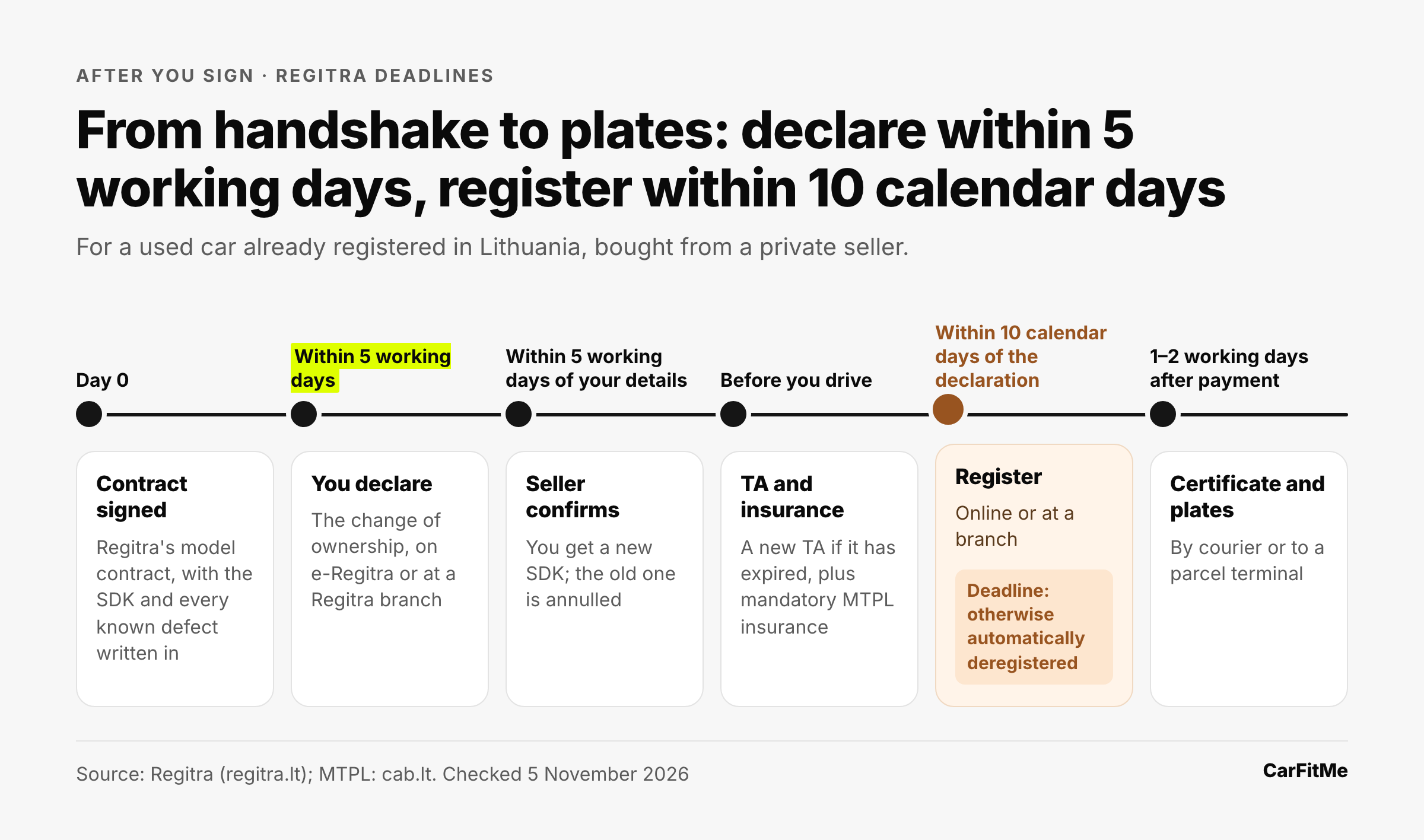
The clock starts at the handshake. All of the steps below come from Regitra's page for cars bought in Lithuania unless another source is linked.
1. Declare the change of ownership within 5 working days. You, the buyer, do this online on e-Regitra or at a Regitra branch with your ID or passport, attaching the contract and the SDK. The seller then confirms within 5 working days of you providing the details. After that you get a new SDK, and the old one is annulled.
2. TA and insurance. To drive on public roads, the car needs a valid roadworthiness test, so book one if it has expired. For passenger cars, the European Commission's summary gives the interval as a first test 3 years after first registration, then every 24 months, and the Lithuanian testing companies' association (in Lithuanian) gives the same. Testing companies issue the certificate. LTSA, the transport safety agency, keeps the list of test stations (in Lithuanian). You also need compulsory third-party liability (MTPL) insurance, which is mandatory in Lithuania.
3. Register within 10 calendar days of the declaration if the car will be used on public roads. Otherwise, in Regitra's words, it is automatically deregistered. You can do it online or at a branch.
4. Certificate and plates arrive 1–2 working days after payment, by courier (€6.99) or to a parcel terminal (€4.90).
Rules checked on 5 November 2026 on regitra.lt, cab.lt, vta.lt and the European Commission's roadworthiness pages. They change, so confirm the current version there before you act. This is general information, not legal or insurance advice.
Taking the car out of Lithuania instead
Buying here to drive the car home? If you're a foreign resident and the car won't be registered or sold in Lithuania, Regitra says the declaration of acquisition isn't required. Registration and car taxes are national, with no common EU rules, so check with your home country's registration authority before you travel. Do the checks above anyway. A fault is harder to argue about from another country.
What to check before you buy
For the car on your screen right now:
- Two lookups on e-Regitra: a valid SDK, and no seizure or pledge in the restrictions search.
- The ad saved, with its year, mileage and "TA iki" date compared against the documents.
- The version known: this engine and gearbox at this mileage. Which known faults should the workshop look for?
- A workshop check with a written result, before any money changes hands.
- Regitra's model contract with the SDK and every known defect written in. Then declare within 5 working days and register within 10 calendar days.
Still choosing? See a sample report: the check plan is the same list, made for one specific car.
FAQ
Can I buy a car in Lithuania as a foreigner?
Yes. Buying a car is a private contract between you and the registered owner, and Regitra's English pages cover foreign-resident buyers. Registering the car in your own name has its own conditions, so check them with Regitra before you pay. If the car won't be registered or sold in Lithuania, Regitra says the declaration of acquisition isn't required.
Do I need to speak Lithuanian to buy a car?
No. Most ads are written in Lithuanian, but autoplius has an English interface, a short key to the field labels covers the rest, and a translator handles the seller's description. Regitra's guidance on buying and registering a car is available in English, and so is its model purchase-sale contract.
How often does a car need technical inspection in Lithuania?
A passenger car's first roadworthiness test (TA) is due 3 years after first registration, then every 24 months, according to the European Commission's summary for Lithuania. If the TA on a used car has expired, it needs a new one before you drive it on public roads. Rules change, so confirm the current interval before you book.
Is car insurance mandatory in Lithuania?
Yes. Motor third-party liability (MTPL) insurance is mandatory in Lithuania, according to the Motor Insurers' Bureau of Lithuania (cab.lt), and Regitra lists it among the steps after you buy a car. You need valid MTPL cover before you drive the car you've bought on public roads. This is general information, not insurance advice.
Does a VIN check replace a pre-purchase inspection?
No. A VIN history report shows what's on record about the car's past, such as recorded events. It can't tell you the car's condition today. Regitra recommends having a car inspected by experts before you buy, and a physical inspection is still needed to confirm the car's actual condition.