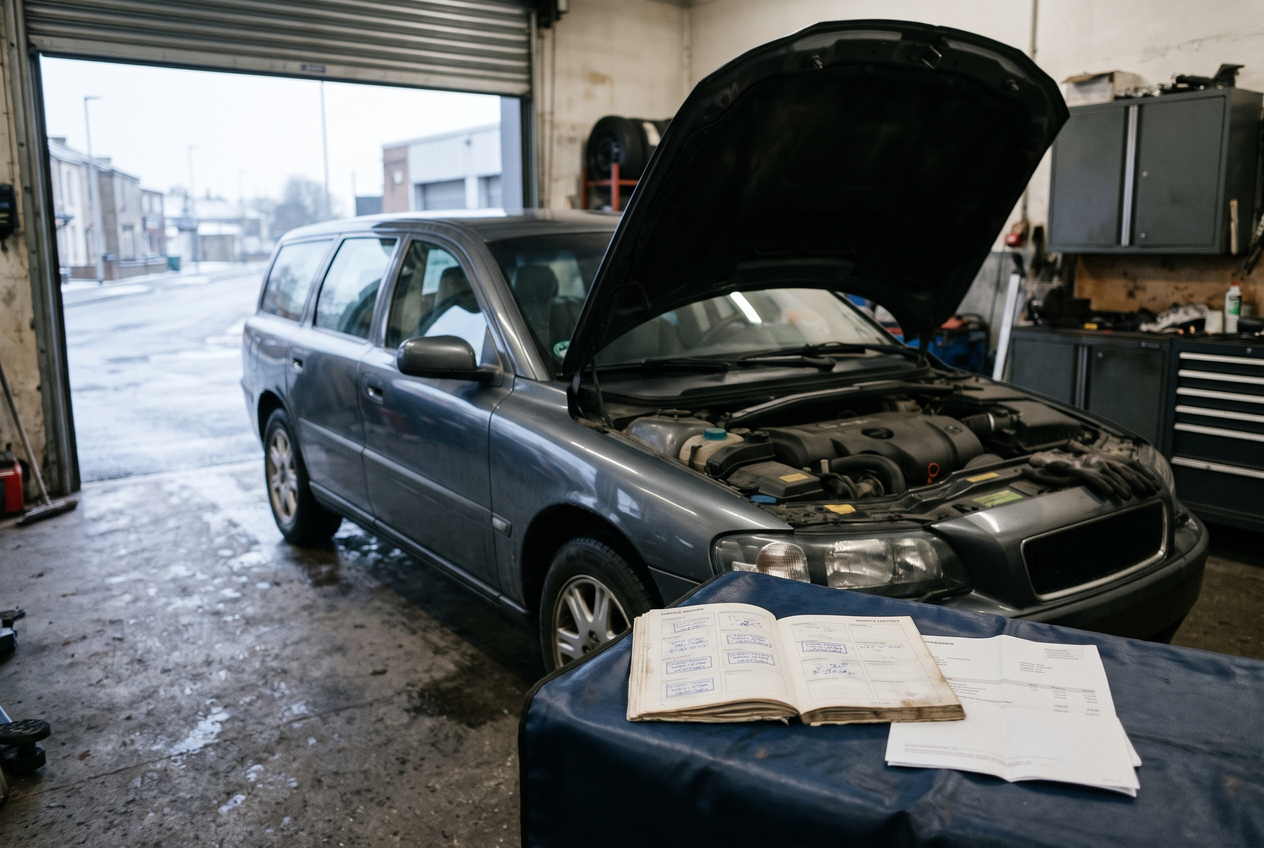
Is 200,000 km on a diesel too much? Not on its own. ADAC, Germany's motoring club, says the bad reputation of high-mileage cars is often unfounded, and that a car's condition and how it was driven tell you more than the odometer (ADAC, May 2024, in German). What decides it is the engine version. Each has its own schedule of parts that come due, from the timing belt to the clutch and the particulate filter, and 200,000 km lands at a different point on each one.
So the useful questions are narrower. What did this version need by now? Can the seller prove it was done? And what will the missing items cost you?
Why the odometer says less than the engine version
ADAC's used-car advice makes a point that sounds backwards at first. A car that built up its kilometers quickly is typically a long-distance car, and long runs at operating temperature can leave it healthier than years of short trips with many cold starts (ADAC, May 2024). Two diesels showing 200,000 km can have lived very different lives.
The badge hides a second difference. "2.0 TDI" on a tailgate has meant more than one engine: VW's EA 288 arrived in 2012, became the EA 288 evo six years later, and comes in several power outputs (Volkswagen, December 2020). The model name doesn't tell you which one sits under the hood, and the engine version (engine code and kW) is what the belt schedule follows. ADAC's table lists intervals by engine, not by model.
For a Golf, Octavia, Passat or another VW-group diesel, look up which 2.0 TDI generation you're looking at, and what each is known for.
The check: ask the seller for the engine code and the power in kW, or find them in the service book. Those two, plus the year, tell you which schedule applies.
Same 200,000 km, five different timing-belt answers
The timing belt keeps the valves and pistons moving in step. If it snaps, ADAC warns, valves can hit pistons, and the result is often serious engine damage (ADAC, April 2025, in German).
Manufacturers set belt intervals anywhere from 60,000 to 240,000 km, and many add a time limit too. Whichever comes first applies. Five of ADAC's own diesel examples:
| Car (ADAC example) | Belt interval |
|---|---|
| VW Golf IV 1.9 TDI, 66 kW (90 hp), 1997–2000 | 60,000 km |
| Nissan Qashqai 1.5 dCi, 85 kW (116 hp), 2014–2018 | 150,000 km or 6 years |
| Peugeot 308 1.6 HDi, 88 kW (120 hp), 2014–2018 | 180,000 km or 10 years |
| Mercedes A 180 d, 85 kW (116 hp), 2018– | 200,000 km or 10 years |
| Škoda Octavia 2.0 TDI, 110 kW (150 hp), 2013–2019 | 210,000 km |
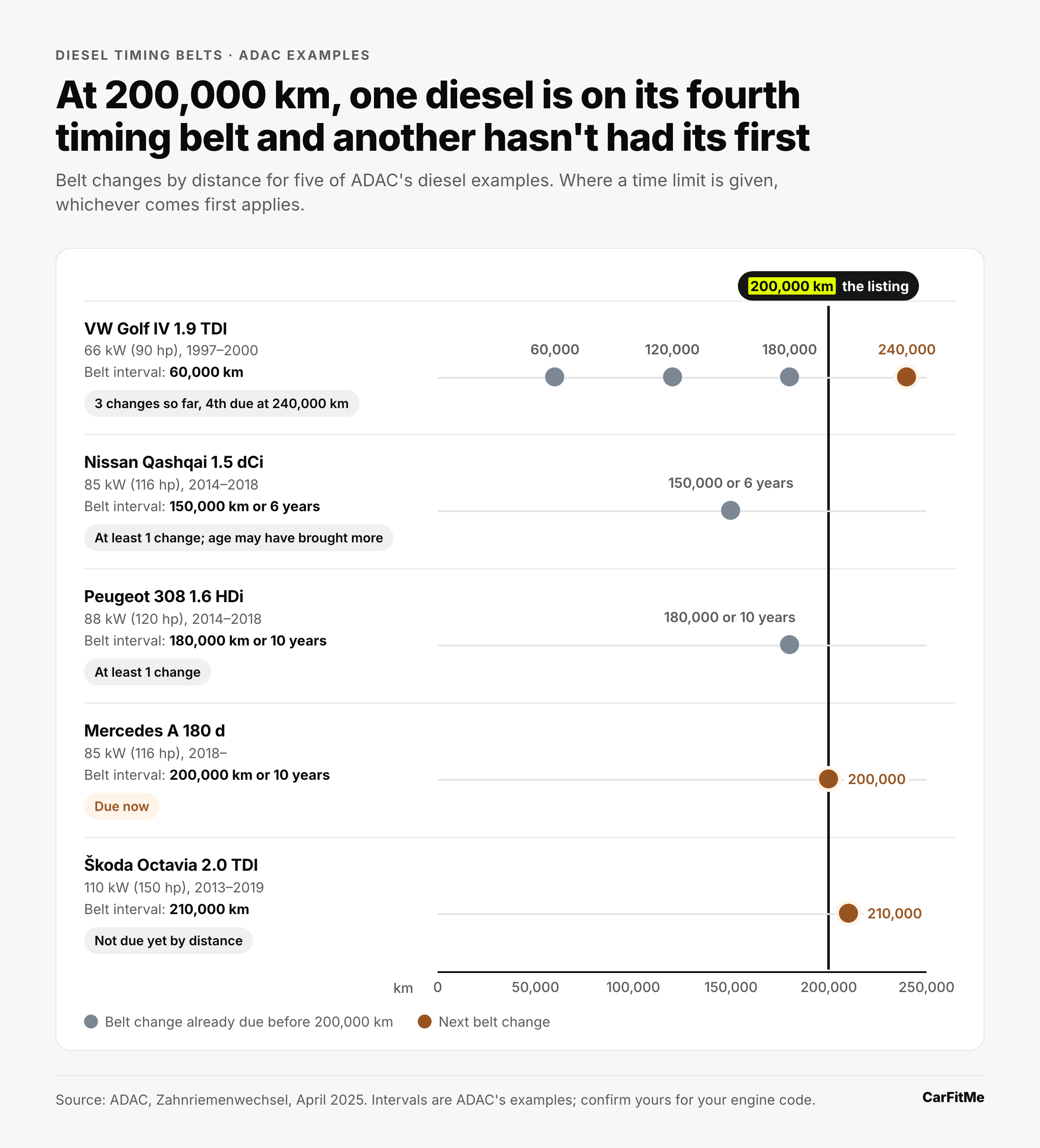
At 200,000 km, that's five different answers (plain arithmetic):
- Golf 1.9 TDI: three belt changes so far (at 60,000, 120,000 and 180,000 km). It should be on its fourth belt, due at 240,000 km.
- Qashqai 1.5 dCi: at least one, at 150,000 km or six years, whichever came first.
- 308 1.6 HDi: at least one, at 180,000 km or ten years.
- A 180 d: due now.
- Octavia 2.0 TDI: not due yet by distance. Its first change comes at 210,000 km.
On the Qashqai and the 308, age can bring a change forward (the A 180 d isn't 10 years old yet). A 2014 Qashqai is well past six years, so by now it may be on its second or third belt even at this mileage.
Across ADAC's table the figure swings widely, even between Golfs: a Golf IV 1.9 TDI at 60,000 km, a Golf VII 1.5 TSI (a petrol) at 240,000 km. Confirm the figure for your engine code in the service book or with a brand workshop.
The check: ADAC says the service history should show the belt change, and a sticker under the hood often records the mileage at the last one. Depending on the model, the water pump is often replaced with the belt, so ask whether it was. If the engine has a chain instead, don't cross it off. ADAC notes that chains wear and stretch too.
ADAC gives no fixed price for a belt change. Labor drives the cost, and on newer cars it can run into the thousands of euros, so get a quote for this engine.
What else is usually due on a diesel by 200,000 km
The euro figures below are German workshop prices from ADAC. Lithuanian quotes will differ, so get one locally.
| Part | What it does | What to ask or check | Cost, where a source gives one |
|---|---|---|---|
| Timing belt kit | Keeps valves and pistons in step | Invoice, sticker, interval for the engine code (see above) | Varies by engine; get a quote (ADAC, April 2025) |
| Clutch and dual-mass flywheel (manual) | The clutch connects engine and gearbox. The flywheel sits between them and smooths out engine vibration | ADAC's warning signs: the clutch bites very late, or judders when you pull away. Have a workshop check the flywheel at the same time | ADAC's example: €1,000 for a clutch including fitting (ADAC, May 2024, Germany). No flywheel figure |
| DPF (diesel particulate filter) | Traps soot from the exhaust and burns it off | Long spells of short trips can stop it cleaning itself. Ask about warning lights, cleaning or replacement. Some older models have replacement intervals of 120,000–180,000 km. Newer cars are usually replaced on ash load measured at service, so ask what yours specifies | Replacement €1,000–3,000, professional cleaning about €400–500 (ADAC, September 2025, Germany) |
| EGR valve and cooler | Routes some exhaust back into the intake to cut emissions | Ask whether either has been replaced. A diagnostic scan shows stored faults | Get a quote for this engine |
| Injectors | Spray fuel into the cylinders | Ask for invoices if any were replaced. The scan covers these too | Get a quote for this engine |
| Turbo | Uses exhaust gas to push more air into the engine | On the test drive, listen for unusual noises and feel whether it pulls evenly. Ask for invoices | Get a quote for this engine |
| AdBlue / SCR system (many Euro 6, all Euro 6d) | Uses AdBlue fluid to turn nitrogen oxides into nitrogen and water | Ask whether any AdBlue or emissions warning has come on | No figure; a low-level warning means a refill, a fault warning means a workshop visit |
AdBlue matters in a Lithuanian winter. SCR spread with Euro 6 type approval for new models from September 2014. AdBlue freezes at about −11 °C, but the tank and dosing system have their own heater, and freezing does no lasting harm (ADAC, March 2025, in German). The real catch is an empty tank: the car won't restart until it's refilled.
Got a diesel listing open? Paste the link to see the known faults for that car and when its engine's weak points tend to show up. Free.
City car or long-distance car? Read it from the dates
Short trips are hard on the particulate filter, because the exhaust often doesn't get hot enough on them to burn the soot off (ADAC, September 2025). The paperwork tells you which kind of life this car had.
Take the dates and mileages from the service invoices and inspection certificates, and divide distance by years. Plain arithmetic, not a benchmark:
- 200,000 km in 5 years is 40,000 km a year.
- 200,000 km in 15 years is about 13,300 km a year.
By ADAC's logic, the first car probably did mostly longer runs. The second may have done much of its distance in town. Neither number is good or bad by itself.
The check: with a low yearly figure, ask the seller how the car was used day to day, and specifically about DPF warning lights, cleaning or replacement.
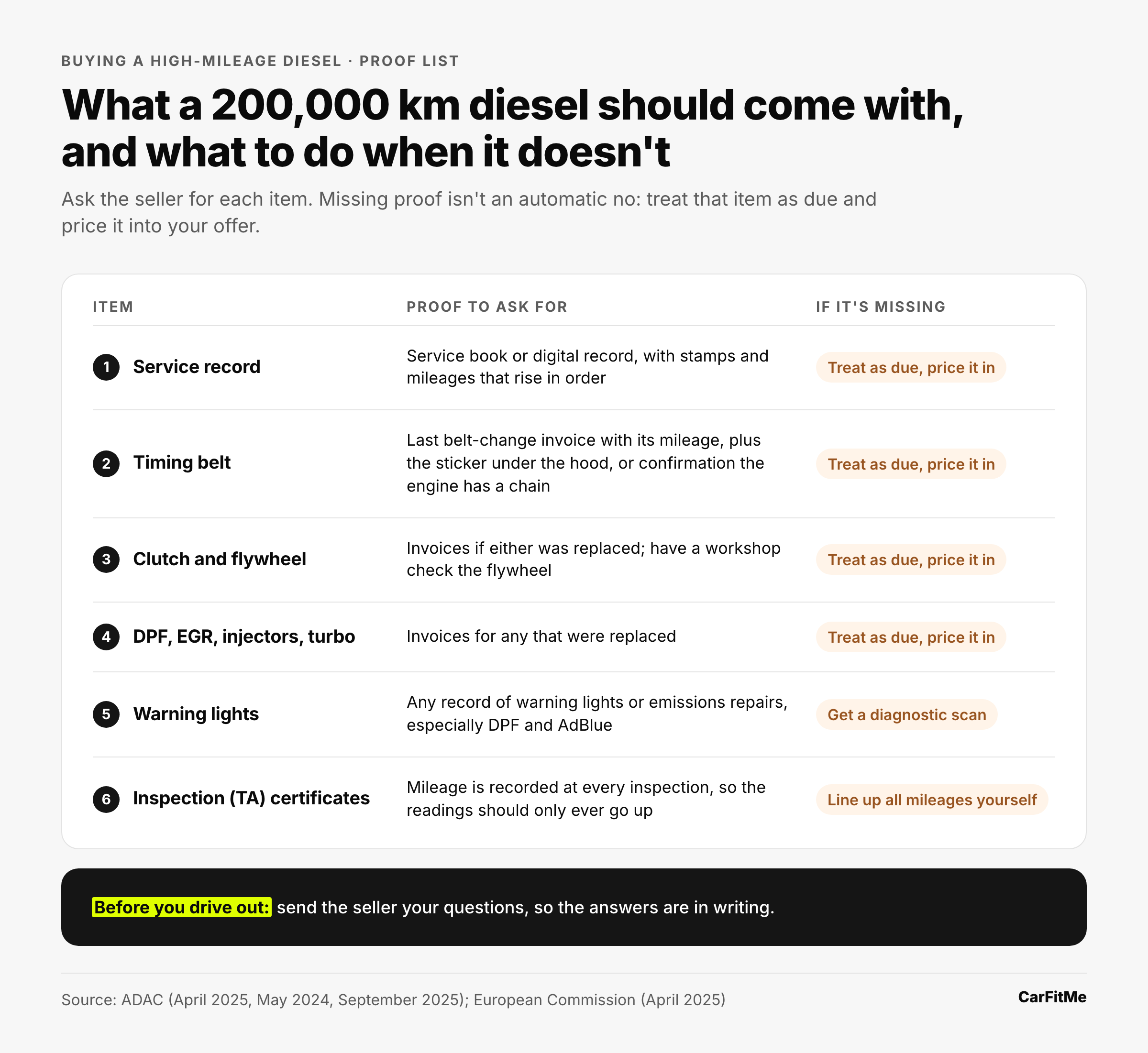
What the seller should be able to show you at 200,000 km
"Check the history" is the usual advice. At this mileage, that means:
- The service book or digital service record, with stamps and mileages that rise in order.
- The last belt-change invoice with its mileage, plus the under-hood sticker, or confirmation that the engine has a chain.
- Invoices for the clutch, flywheel, DPF, EGR, injectors and turbo, if any were replaced.
- Inspection (TA) certificates. EU rules require the mileage to be recorded at every periodic inspection (European Commission, April 2025), so the readings should only ever go up.
- Any record of warning lights or emissions repairs, especially DPF and AdBlue.
Missing proof isn't an automatic no. Treat that item as due and price it into your offer. Before you drive out, send these questions for the seller before a viewing, so the answers are in writing.
Is the 200,000 real? A word on mileage fraud
Tampering with the mileage is a punishable offense under EU rules. The weak spot is a car's early years: the first inspection often comes only after four years, and the European Commission notes that much of the tampering has already happened by then (European Commission, April 2025).
Studies cited by the European Parliament in 2018 estimated that 5–12% of used cars sold domestically and 30–50% of those sold across borders had tampered odometers (European Parliament, 2018). For a car imported into Lithuania, the cross-border range is the one to keep in mind.
The check: line up the mileage on invoices, inspection certificates and the dashboard. ADAC's warning is about unusually low mileage on old cars, but a 200,000 km reading can still have been lowered from a higher one.
Put the missing items into your offer
List every item from the parts table that should be done by now but has no proof, and get a quote for each from a workshop that knows this engine. ADAC's German figures are a rough reference only (DPF €1,000–3,000 new or €400–500 cleaned, €1,000 for the clutch in its example). For the belt, flywheel, injectors and turbo, the local quote is the number.
ADAC's rule of thumb helps here: a repair makes sense when it costs no more than about half of what the car is worth in working order (ADAC, May 2024). If the unproven items add up past that line, the listing price no longer describes the deal.
A pre-purchase check costs about €100 at many workshops in Germany, says the same ADAC page. In Lithuania, ask for the price when you book.
What to check before you buy
- Find the engine code and its belt interval (or confirm it has a chain), and compare it with the listing's mileage and age.
- Ask for the belt-change invoice, and look for the sticker under the hood.
- On the test drive, pull away gently and feel for a late bite or judder from the clutch, and watch for DPF, AdBlue or engine warning lights.
- Line up the mileages on the invoices, the inspection certificates and the dashboard, and check that they only ever rise.
- Have a workshop run a diagnostic scan and check the clutch and flywheel, DPF, injectors and turbo, with your list of unproven items in hand.
None of this replaces a workshop inspection. Estimates and prices change, so confirm them for your car.
See a sample report to see what a check plan for one specific car looks like.
FAQ
How many km does a diesel engine last?
There's no single figure, and no primary source gives one. How long a diesel lasts depends on the engine version, how the car was used and how well it was maintained, which is why ADAC treats condition and use as more telling than the odometer. Look at what this version's schedule calls for and what the seller can prove was done.
Is 300,000 km a lot on a diesel?
It's more wear, but the same logic applies as at 200,000 km. Belt intervals in ADAC's examples run from 60,000 to 240,000 km, so by 300,000 km every belt engine in that range is past its first change. Ask for the invoices, check the clutch, DPF and injectors, and price in anything that isn't proven.
What is considered high mileage in km?
There's no official threshold, and ADAC doesn't set a kilometer limit for used cars. A better measure is distance per year, worked out from the service and inspection records, together with where the car sits on its engine's maintenance schedule. 200,000 km over 5 years and over 15 years describe very different cars.
Is 200,000 km too much for a car?
Not by itself, and the principle is the same for petrol cars. Belt intervals vary between petrol engines too, according to ADAC's table. The parts specific to diesels are the particulate filter and, on many Euro 6 cars, the AdBlue system.
Should I buy a car with 200,000 km?
Yes, if the proof is there, or if the missing items are priced into your offer and a workshop has checked the car. Ask for the service record, the belt-change invoice and the inspection certificates. Anything that should be done by now but can't be proven counts as due.